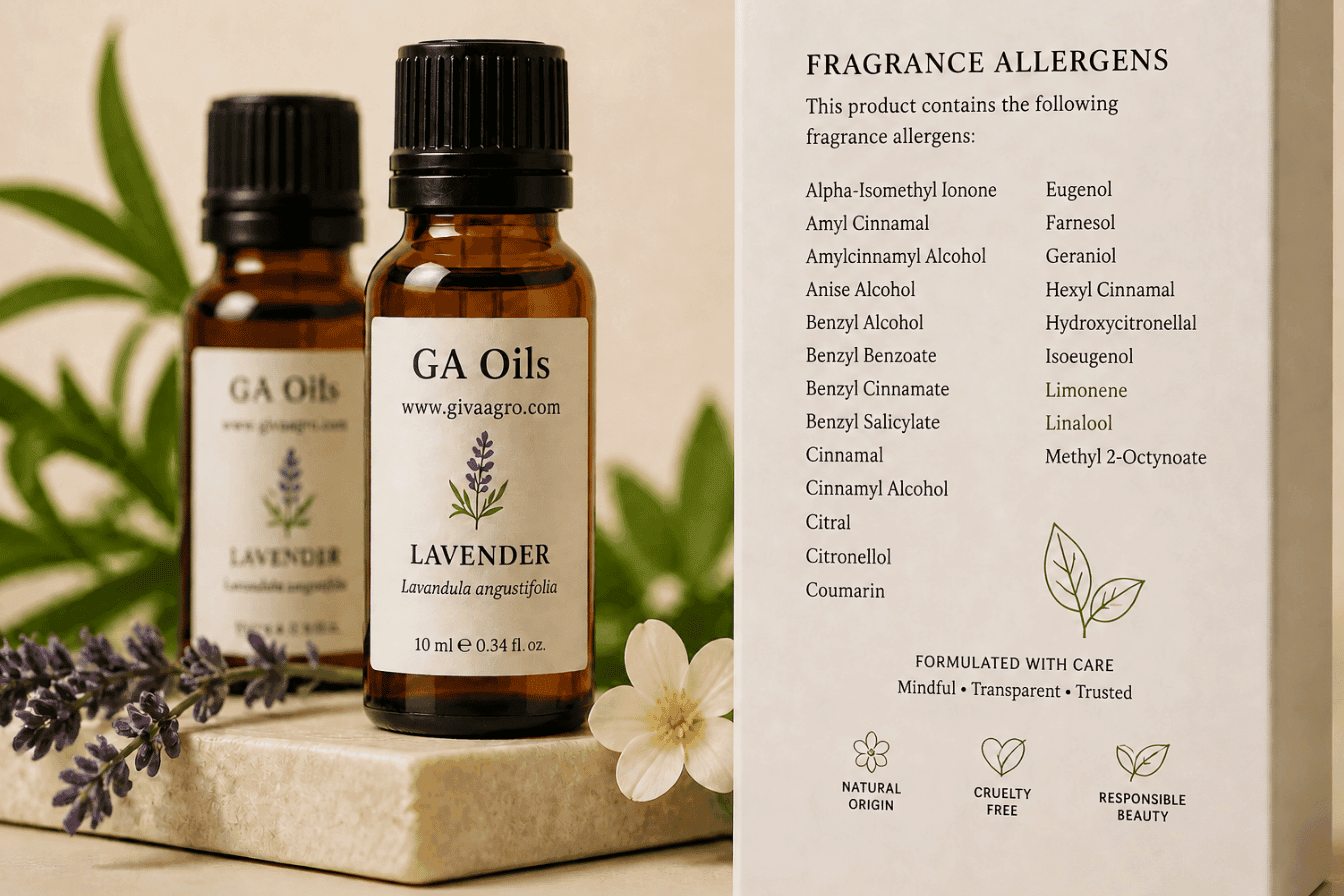
Since 31 July 2026, every cosmetic product placed on the EU market has had to follow a much longer fragrance allergen list. Regulation (EU) 2023/1545 took the number of fragrance allergens that must be named on the label from 26 to more than 80. For the first time, it also names many essential oils themselves, including lavender, peppermint, ylang ylang, rose and sandalwood.
If you buy essential oils for skincare, haircare, massage oils, soaps or any other cosmetic sold in the EU, this changes what goes on your label and what you need from your supplier. This guide explains the rule, the dates, how to work out what to declare and which documents to ask for with every order. It is written for brand owners and formulators buying bulk essential oils or private label oils for the European market.
What Regulation (EU) 2023/1545 changed
The EU Cosmetics Regulation, (EC) No 1223/2009, has always required certain fragrance allergens to be named in the ingredients list instead of being covered by the single word "Parfum". Regulation 2023/1545 amended Annex III of that regulation and made four changes that matter to essential oil buyers:
More allergens: the list grew from 26 entries to more than 80.
Essential oils named in their own right: around 25 natural oils and extracts are now on the list, so the oil itself has to be declared once it passes the threshold, not only the molecules inside it.
More single molecules found in essential oils: including linalyl acetate, menthol, camphor, carvone, pinene, terpineol, beta-caryophyllene, geranyl acetate, eugenyl acetate, methyl salicylate, anethole, santalol, sclareol and vanillin.
Fixed label names: each allergen must be declared under the exact name given in Annex III. Some entries cover a group; for example, the isomers geranial and neral are declared together as "Citral".
The labelling thresholds did not change. An allergen must be named when its concentration in the finished product exceeds 0.001% (10 ppm) in leave-on products or 0.01% (100 ppm) in rinse-off products.
The dates: 31 July 2026 and 31 July 2028
From 31 July 2026: every cosmetic product placed on the EU market must be labelled to the new list. The date applies to each individual unit, not to the product type, so a product you have sold for years still needs the new labelling on every unit placed on the market after this date.
Until 31 July 2028: units placed on the market before 31 July 2026 with the old labelling can still be sold by distributors and retailers. After 31 July 2028, every unit on sale must comply.
"Placed on the market" means first supplied in the EU by the manufacturer or importer. Later sales, for example from a distributor to a shop, count as "making available". In practice, any production run you ship to the EU now needs labels that follow the new list.
Which essential oils are now on the list
These oils and extracts are now listed as allergens in their own right:
Lavender (Lavandula oils and extracts)
Peppermint (Mentha piperita) and spearmint (Mentha viridis)
Ylang ylang (Cananga odorata)
Rose flower oil and extract, and jasmine oil and extract
Sandalwood (Santalum album)
Geranium (Pelargonium graveolens)
Patchouli (Pogostemon cablin)
Lemongrass
Clove (Eugenia caryophyllus)
Cinnamon bark (Cinnamomum zeylanicum) and cassia leaf (Cinnamomum cassia)
Eucalyptus (Eucalyptus globulus)
Atlas cedarwood (Cedrus atlantica) and Virginia cedarwood (Juniperus virginiana)
Bay laurel leaf (Laurus nobilis)
Citrus oils: lemon peel, bitter orange peel and flower (neroli), and bergamot peel
Pine (Pinus mugo, Pinus pumila) and turpentine
Peru balsam, narcissus extract and lemon verbena absolute
Where one of these oils is part of a fragrance declared as "Parfum", it can no longer stay hidden inside that word once its concentration passes the threshold. Most of these oils also contain listed molecules, so a single oil can add several names to a label. Use the exact names from Annex III on the label; the common names above are only a guide.
How to work out what goes on your label
You need two numbers: how much of the oil is in your product, and how much of each allergen is in the oil. The second number comes from your supplier's allergen declaration.
Allergen in the product (%) = oil in the product (%) × allergen in the oil (%) ÷ 100
Then compare the result with 0.001% for a leave-on product or 0.01% for a rinse-off product. If it is higher, the allergen goes in the ingredients list.
Example 1: lavender oil in a leave-on body oil
A body oil contains 2% lavender oil. The supplier's declaration shows 30% linalool, 35% linalyl acetate and 0.5% limonene.
Linalool: 2 × 30 ÷ 100 = 0.6%, far above the 0.001% threshold, so "Linalool" is declared.
Linalyl acetate: 2 × 35 ÷ 100 = 0.7%, also declared.
Limonene: 2 × 0.5 ÷ 100 = 0.01%, ten times the leave-on threshold, so it is declared too.
The lavender oil itself is on the list and appears in the ingredients list in any case.
Example 2: one oil, two kinds of product
A peppermint oil with 40% menthol and 1.5% limonene is used at 0.5%.
In a shampoo (rinse-off): menthol is 0.5 × 40 ÷ 100 = 0.2%, above 0.01%, so "Menthol" is declared. Limonene is 0.5 × 1.5 ÷ 100 = 0.0075%, below 0.01%, so it does not have to be.
In a body lotion (leave-on): the same 0.0075% limonene is above 0.001%, so here it must be declared.
The figures above are examples. Real values vary with the crop, the region and the batch, so always calculate from the declaration for the oil you are actually buying.
The documents to ask your essential oil supplier for
Allergen declaration against the current Annex III list: it should cover every entry as amended by Regulation 2023/1545, with a percentage or "not detected" for each. A declaration covering only the old 26 allergens is no longer enough for EU labels, so check the date and the list version on the document.
GC-MS report for the batch: shows the oil's composition and supports the allergen figures.
Certificate of Analysis: identity, physical constants and results against the specification for the batch. Our guide on how to read a Certificate of Analysis shows what to check line by line.
IFRA certificate or statement: the maximum use level by product category under the IFRA Standards. IFRA is an industry standard, separate from EU law, but most perfumers and safety assessors ask for it.
Safety Data Sheet (SDS): the hazard classification of the oil itself, which you need for storage, transport and any non-cosmetic product.
Specification sheet and Certificate of Origin: for your Product Information File and your import file.
Your safety assessor uses the allergen figures in the Cosmetic Product Safety Report, and they belong in the Product Information File. If your label changes, update the product's CPNP notification as well.
Common mistakes to avoid
Relying on an old declaration that covers only the original 26 allergens.
Forgetting that the oil itself is now on the list, as with lavender, peppermint and ylang ylang.
Using synonyms or trade names instead of the exact Annex III names.
Applying the rinse-off threshold to a leave-on product such as a massage oil, serum or body lotion.
Changing supplier, origin or grade without recalculating. Lavender from a different region or harvest can have quite different linalool and linalyl acetate levels.
Leaving the check until the artwork stage. Five or six extra names can overflow a small label, so check the space early.
What about the UK and non-cosmetic products?
Great Britain sets its own cosmetics rules and has not automatically followed Regulation 2023/1545. Many brands that sell in both markets label to the EU list so one label works for both, but check the current GB requirements with your UK Responsible Person before you print.
The rules in this guide are for cosmetics. Essential oils sold for diffusers, candles, wax melts or home fragrance follow the EU CLP Regulation instead, with hazard pictograms and sensitiser warnings based on the oil's Safety Data Sheet. Detergents and cleaning products have their own allergen labelling rules. For candle and home fragrance formulas, see our fragrance oils range.
Frequently asked questions
Does Regulation 2023/1545 apply to products already on sale?
Units placed on the EU market before 31 July 2026 can still be sold until 31 July 2028. Every unit placed on the market from 31 July 2026 must carry labelling that follows the new list.
Is lavender oil an allergen under EU cosmetics law?
Yes. Lavender oil is one of the essential oils now listed in Annex III. When its concentration in the finished cosmetic exceeds 0.001% in a leave-on product or 0.01% in a rinse-off product, it must be named in the ingredients list, together with any listed molecules it contains above the threshold, such as linalool and linalyl acetate.
What are the labelling thresholds?
0.001% (10 ppm) for leave-on products and 0.01% (100 ppm) for rinse-off products, measured in the finished product, not in the essential oil.
Do I need to test my finished product?
Most brands calculate the figures from their suppliers' allergen declarations. Laboratory testing of the finished product is a useful check for formulas with high essential oil levels or many natural ingredients.
Can you supply allergen declarations for your oils?
Yes. For every oil we quote, we can send an allergen declaration against the current EU list, together with the batch GC-MS report and Certificate of Analysis, the Safety Data Sheet and, where applicable, an IFRA statement.
Buying essential oils for EU cosmetics?
We supply more than 400 essential oils, carrier oils, hydrosols, absolutes and oleoresins, steam distilled and cold pressed in India, in bulk or filled under your own label. Send us your shortlist and the products they will go into, and we will send the batch documents with the quotation.
Request a quote or samples · Bulk essential oils · Steam distilled essential oils · Private label essential and carrier oils · Download the oils brochure (PDF)
Related guides: How to read a Certificate of Analysis · Private label vs white label vs OEM
Sources: Regulation (EU) 2023/1545 on fragrance allergen labelling · Regulation (EC) No 1223/2009 on cosmetic products