Most supplement brands do not own a factory. They work with a nutraceutical manufacturer that formulates, produces, fills and labels the product, while the brand owns the name, the customer and the market. Done well, this gets a range to market in weeks, not years, and keeps capital in marketing rather than machinery.
This guide walks through how private label and white label nutraceutical manufacturing works in practice: what you can make, what to send in your brief, the seven steps to a first shipment, what drives the price, and the documents your importer will ask for in Europe, the UK, Australia and New Zealand.
Private label or white label: the short version
White label: an existing, proven formula with your brand on the pack. It is the fastest and lowest-cost route, but another brand may sell the same formula.
Private label: a formula from the manufacturer's library, adapted to your dose, format, pack or market, and sold only under your brand.
Contract manufacturing: your own formula and specification, produced under the manufacturer's quality system.
Ownership, exclusivity and cost differ for each. Our guide Private label, white label, contract manufacturing or OEM: which do you need? compares them in detail.
What you can make
Formats
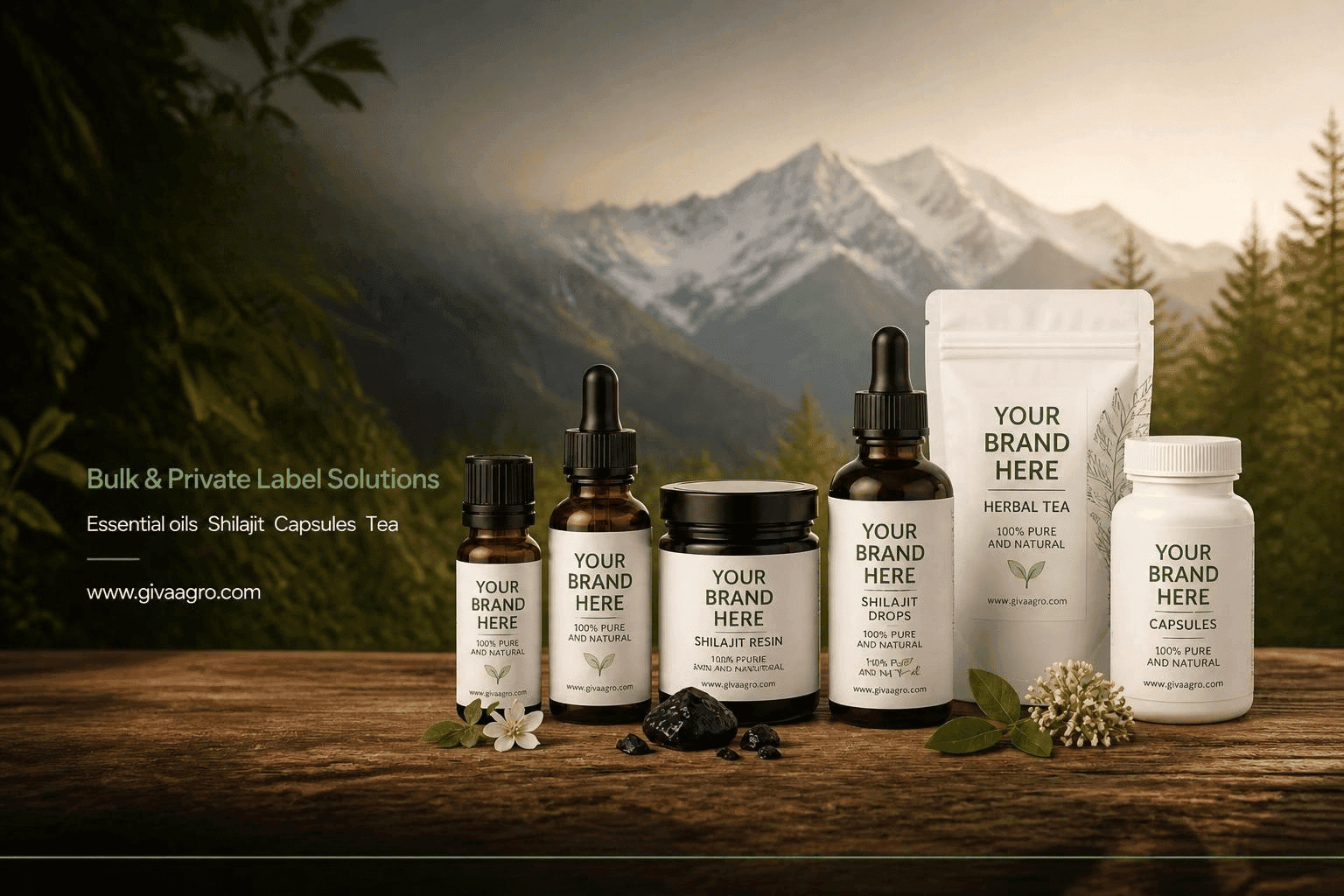
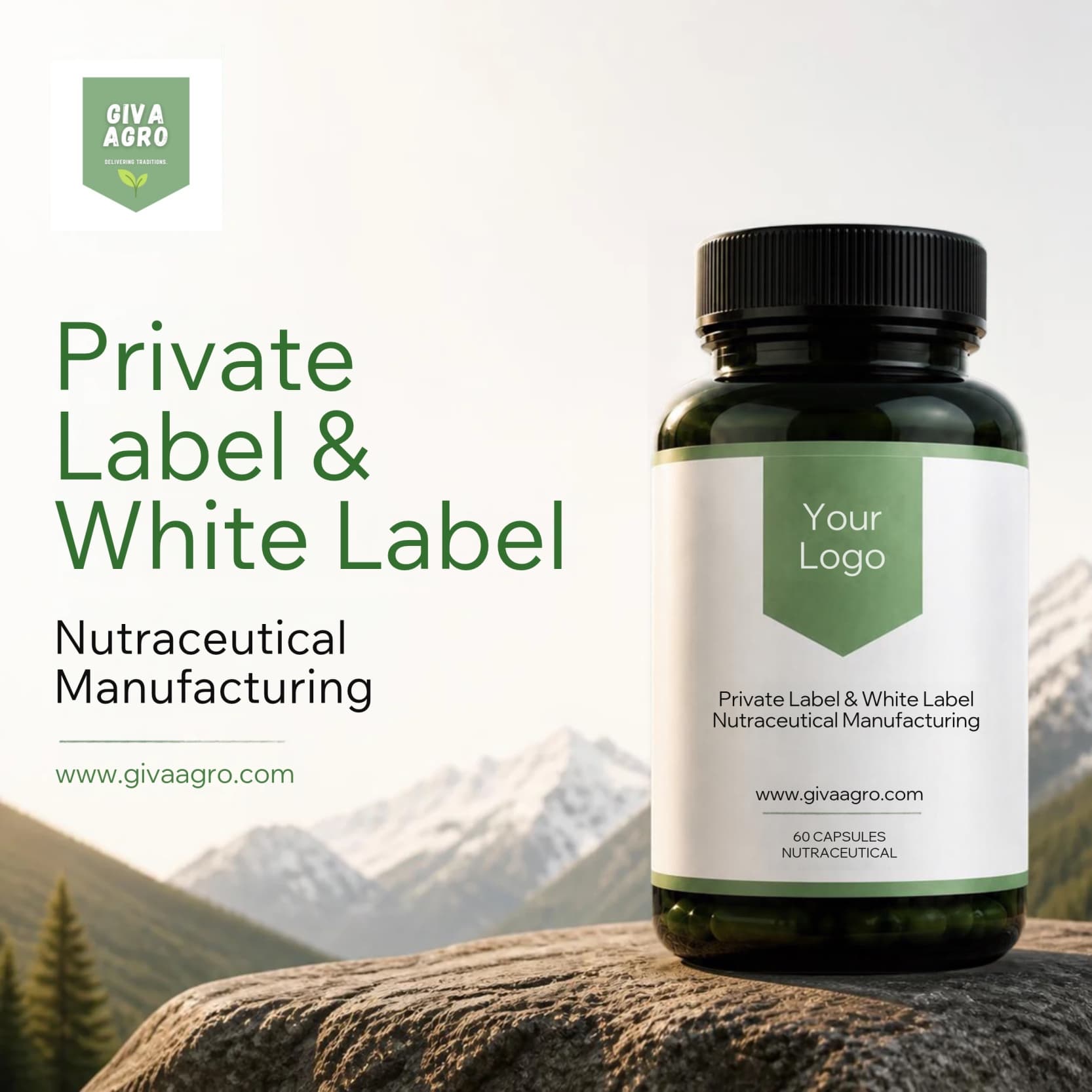
Capsules: vegetarian (HPMC) capsules in standard sizes, the most popular format for herbal blends and extracts.
Tablets: suited to higher doses and multi-ingredient formulas.
Softgels: for oils and oil-soluble ingredients.
Powders: tubs or pouches for drink mixes and larger daily servings.
Sachets and stick packs: single servings for travel, sampling and subscription boxes.
Packaging and finishing
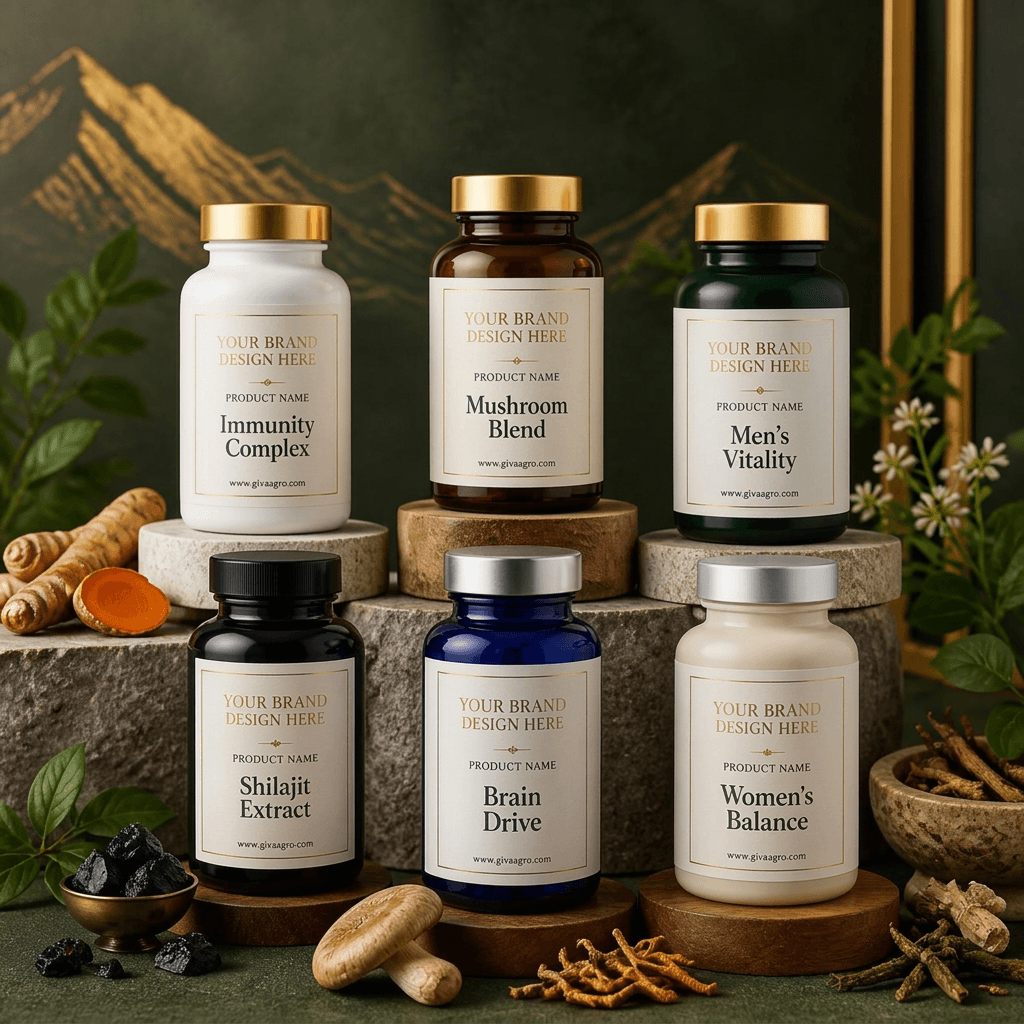
Containers: HDPE or PET bottles, amber glass jars and stand-up pouches, in counts that suit your market.
Your branding: printed labels, retail cartons and product leaflets, applied and packed for you.
Export packing: cartons and pallets marked for your importer, with batch codes and best-before dates set at production.
Giva Agro's library holds more than 500 formulations across these formats. See the full range on our herbal supplement private label page and the pack options on our packaging page.
What to send in your first brief
A specific brief gets a useful first reply, with indicative pricing, instead of three emails asking for details. Include:
Destination market: each country you will sell in, because rules on ingredients, doses and claims differ.
Product: the formula or ingredient list you have in mind, or the category and benefit area if you want us to propose one.
Format and pack: for example, 60 vegetarian capsules in an amber glass jar.
Volume: your first order and the expected annual quantity per product.
Target price: your target landed cost or retail price, if you have one.
Requirements: vegan, organic, allergen-free or other positioning you need to prove on paper.
From brief to first shipment in seven steps
Brief and indicative quote. Send the brief above. We reply within one business day with indicative pricing and any points that will not work in your market.
Formula and specification. We confirm the formula, the dose per serving and the finished-product specification you will approve.
Samples. Samples ship in 7 to 10 working days once the formula is agreed. Test them for taste, smell, capsule fill and stability in your own conditions.
Label and artwork check. We supply the composition data your label needs. You or your importer confirm the wording against local rules, and only then send artwork to print.
Order and pre-production approval. You confirm the order, the pack and the Incoterm. We confirm a realistic production and dispatch date.
Production and batch testing. Each batch is made under GMP and tested before release. You receive the Certificate of Analysis for your batch. Independent testing at an accredited lab of your choice can be added.
Documents and shipment. The goods ship with the export documents your importer needs to clear and place them on the market.
What drives the price per unit
Ingredients: standardised extracts with a declared active content cost more than plain powders, and premium or organic sources cost more again.
Dose and format: a high dose may need two capsules per serving or a larger capsule size; softgels and sachets cost more to fill than capsules.
Count per pack: a 120-count bottle costs less per serving than a 30-count.
Packaging: glass, printed cartons and leaflets add cost; custom boxes often have their own supplier minimums.
Order size: set-up costs are spread across the run, so price per unit falls as volume rises.
Testing scope: extra panels such as pesticides, additional heavy metals or independent lab reports add cost but save trouble at the border.
Incoterm: an EXW price and a DAP price are not comparable. Always compare quotes on the same delivery basis.
Minimum orders
Private label supplements usually start at 1,000 units per product, or 25 kg for bulk powders. If you are testing a new market with a smaller volume, tell us the number. We will suggest the most economical way to start, for example a stock format with your label before you invest in custom cartons.
Documents your importer will ask for
Certificate of Analysis (COA): for every batch, with identity, active content, heavy metals and microbiology. Our guide How to read a Certificate of Analysis explains what to check.
Product specification: the agreed composition per serving and the release limits.
Certificate of Origin and Certificate of Free Sale: often requested by customs and by authorities at notification.
Declarations: allergen, GMO and vegan or vegetarian status, where your label makes those statements.
Manufacturing certificates: GMP and other certificates that your importer or retailer asks for during supplier approval.
Who is responsible in your market
The manufacturer supplies the evidence. Placing the product on the market is the job of a business based there: you, your importer or an agent you appoint.
European Union: the business named on the label, or the EU importer, is responsible for compliance. Most Member States require notification before first sale, some keep national lists of permitted plants, and only authorised health claims may be used. Our EU import checklist covers each step.
United Kingdom: Great Britain has its own rules since Brexit, including its own register of permitted health claims.
Australia: most supplements are listed complementary medicines. An Australian sponsor holds the entry with the TGA and applies for GMP clearance for the overseas manufacturer.
New Zealand: dietary supplements fall under the Dietary Supplements Regulations 1985, and the importer must be registered with MPI.
Five mistakes that delay a launch
Printing artwork too early: label wording, doses and claims should be checked for each market before anything goes to print.
Ordering custom cartons before samples are approved: a change of count or capsule size can make the whole carton run unusable.
Leaving ownership unwritten: agree in writing who owns the formula and whether it is exclusive to you.
Comparing quotes on different terms: check the Incoterm, the testing included and the pack before comparing prices.
Skipping a test on the first order: an independent test of the first batch builds confidence with your importer and your customers.
Frequently asked questions
What is the minimum order for private label supplements?
Usually 1,000 units per product, or 25 kg for bulk powders. Tell us your volume if it is smaller and we will suggest a way to start.
How long do samples take?
Samples ship in 7 to 10 working days once the formula is agreed.
Can you manufacture my own formula?
Yes. Send the formula and the specification, and we will check feasibility, source the ingredients and produce to your specification.
Do you offer vegetarian capsules?
Yes. Vegetarian HPMC capsules are available in standard sizes.
Do you ship to Europe, the UK, Australia and New Zealand?
Yes. We quote ex works, FOB, CIF or delivered to your door, and supply the export documents with every shipment.
Who checks that my label is compliant?
We provide the composition and supporting data, and flag anything that will not work in your market. Final responsibility for the label sits with the business placing the product on the market, usually you or your importer.
Ready to start your supplement range?
Send us the market, the product, the format and the volume. You will get indicative pricing within one business day, and samples in 7 to 10 working days once the formula is agreed.