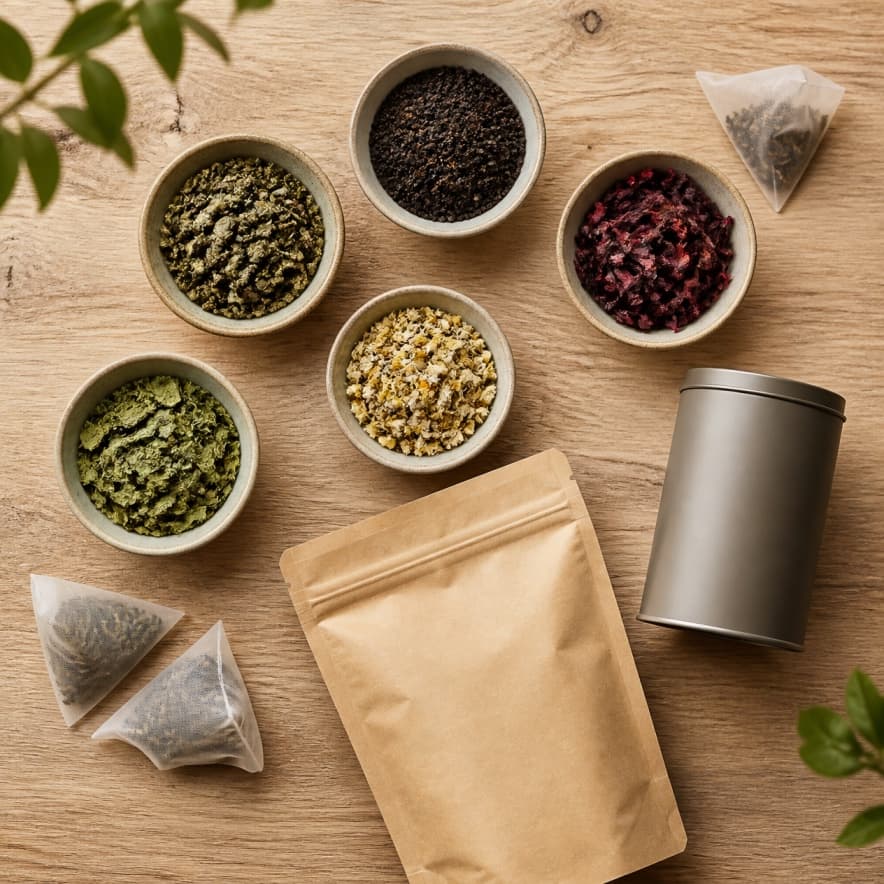
Launching a tea or herbal infusion range under your own brand looks simple from the outside: choose some blends, design a box, place an order. In practice, the first order is decided by four things most brand owners only discover halfway through: the pack format, the real minimum order, the print timeline and the lab tests your market expects.
This guide covers each of them for buyers in Europe, the UK, Australia and New Zealand sourcing private label tea from India. It is based on how we run private label tea manufacturing from Dehradun, with leaf from Himalayan foothill growers and Assam estates.
Start with the channel, then choose the format
The format decides where a tea can sell. A pyramid bag looks right in a delicatessen and wrong in a hotel room; an envelope does the opposite. Decide where the tea will be sold first, then build the pack around it.
Pyramid teabags: the premium retail format, with room for whole leaf and visible botanicals. They come in two very different materials. Plant-based mesh composts in a food waste stream; nylon mesh does not. European retailers now check that claim, so make sure your label says exactly which one you are buying.
Paper teabags: side-fill or bottom-fill, single or double chamber, with or without tag and string. The everyday supermarket and food service format, and usually the lowest cost per cup.
Envelopes: each teabag wrapped in a printed foil or paper sachet. Foil keeps aroma and moisture out longer, which is why hotels, airlines and sampling programmes use it.
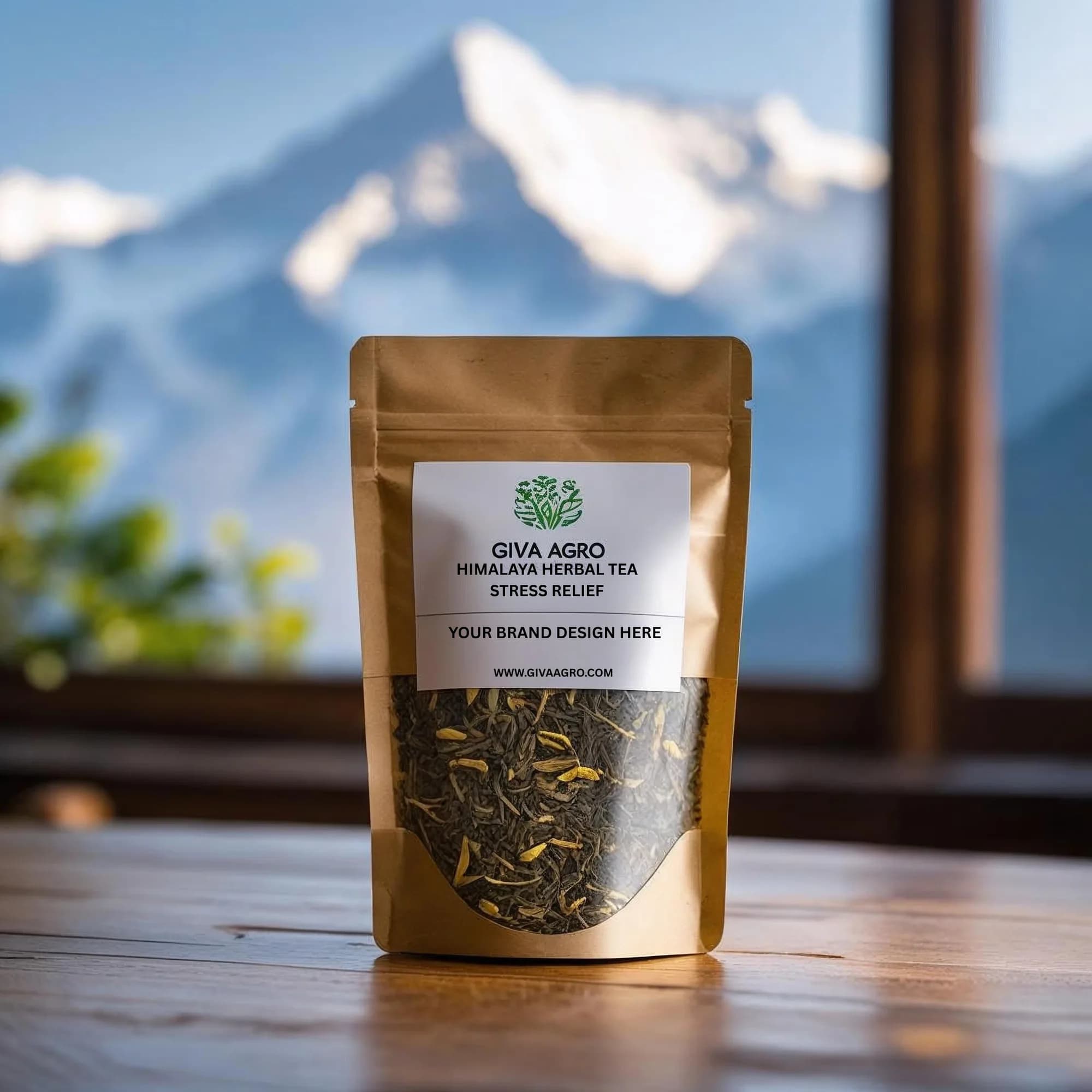
Loose leaf: whole leaf or CTC in caddies, tins and pouches for specialty retail and online shops, where customers want to see the leaf.
Bulk: blended leaf in 10 kg and 25 kg foil-lined, food-grade sacks for repackers and brands with their own filling line.
If you are not sure, start with one format in one channel. Most first ranges we make are three to six blends in a single pack style, which keeps print costs and minimums under control. The full list of teabag constructions, envelopes and cartons is on our packaging and private label finishing page.
What the minimum order really means
Private label tea has two kinds of minimum, and the second one is the one that catches people out.
Finished retail packs: from around 1,000 units per SKU. A unit is the pack the shopper buys, so a carton of 20 pyramid bags counts as one unit.
Bulk blended leaf: from 25 kg per blend.
Printed components: custom tags, printed envelopes and cartons each have their own print minimums, set by the printer rather than the blender. With several blends in one design, these often decide the real size of a first order.
Ways to keep a first order manageable:
Launch fewer blends and add more once you know what sells.
Use one carton design across blends and change only the blend name and colour panel.
Start from a house blend that is already documented, then adjust it, instead of developing every recipe from scratch.
Test the market with loose leaf or bulk while the printed retail packs are being prepared.
We keep more than 40 house blends ready to private label, from Assam CTC and Earl Grey to Tulsi green, moringa mint, chamomile lemongrass and rooibos. You can see them on our herbal tea blends page.
From brief to shipment: a realistic timeline
Brief. The most useful brief describes the cup, not a list of ingredients: how it should taste, how strong, what it must cost landed and who it is for.
Samples. Blend samples arrive in 7 to 10 working days. Two or three rounds to sign-off is normal.
Specification. The approved blend is documented: formula, infusion time and temperature, liquor colour and strength, so batch fifty tastes like batch one.
Artwork. We send dielines, and your designer prepares the artwork to your market's labelling rules.
Production. Three to five weeks from blend and artwork approval. Printing of tags and cartons, not blending, is usually the critical path, so approve artwork early.
Testing and documents. Batch testing and the export paperwork are prepared before the goods leave.
The lab tests European and UK buyers ask for
Tea and herbal infusions are food, and in the EU they fall under the general contaminant and pesticide rules. These are the tests that come up in almost every first order:
Pesticide residues: a multi-residue screen against the destination market's maximum residue levels (MRLs). Under Regulation (EC) No 396/2005, where no specific MRL exists, a default of 0.01 mg/kg applies, so "low" is not enough; the result has to be within the EU limit for each substance. Ask for tea-specific residues such as anthraquinone to be included.
Pyrrolizidine alkaloids (PAs): natural plant toxins that enter herbal crops through weeds harvested alongside them. Since July 2022, EU maximum levels apply: 150 µg/kg for dried tea and flavoured tea, 200 µg/kg for most dried herbal infusions, and 400 µg/kg for infusions made only of rooibos, anise, lemon balm, chamomile, thyme, peppermint or lemon verbena.
Ethylene oxide: not permitted as a treatment in the EU, and any residue above the limit of quantification makes a lot non-compliant. Ask for a test or declaration, especially for blends containing spices or seeds.
Mycotoxins: relevant for blends with spices or roots. Ochratoxin A limits include 10 µg/kg for dried herbs and 20 µg/kg for liquorice root, and aflatoxin limits apply to spices such as ginger and turmeric.
Heavy metals: lead, cadmium, mercury and arsenic, tested by ICP-MS where your market or customer requires it.
Microbiology: total plate count, yeast and mould, E. coli and Salmonella.
Moisture: declared per batch. It is the parameter that decides shelf life in a foil pack.
For a first order, ask for the manufacturer's Certificate of Analysis and an independent report from an ISO/IEC 17025 accredited laboratory on the same batch. If you have not compared the two before, our guide on how to read a Certificate of Analysis shows what to check line by line.
Labels, claims and documents
Labels
In the EU, Regulation (EU) No 1169/2011 sets the label content. For tea, that means an accurate name, the ingredients in descending order with percentages for any ingredient named on the front (for example "with lemongrass"), allergens, net quantity, best-before date, lot number, preparation instructions and the name and address of the EU business responsible. The UK follows the same structure with a UK address. Flavourings, such as the bergamot in Earl Grey, must be declared correctly as flavourings.
Australia and New Zealand follow the FSANZ Food Standards Code, and New Zealand importers also need MPI food importer registration.
Claims
Functional blends sell well, but words like "detox", "immunity" or "sleep" are health claims. In the EU and UK they must comply with Regulation (EC) No 1924/2006, and Australia and New Zealand have their own limits. Write the blend description around taste, ingredients and the moment it is made for, and check every claim with your importer before printing.
Documents for each shipment
Certificate of Analysis for the batch
Product specification sheet
Allergen and GMO declarations
Certificate of Origin
Phytosanitary certificate, where the destination requires one
For certified organic lines going to the EU, a certificate of inspection issued in TRACES
A short checklist before you send a brief
Which channel: retail, online, hospitality or repacking?
Which format: pyramids, paper bags, envelopes, loose leaf or bulk?
How many blends in the first range, and how many units of each?
What landed price per unit do you need?
Which market, so the tests and label rules match it?
Organic or conventional?
Frequently asked questions
What is the minimum order for private label tea?
Around 1,000 units per SKU for finished retail packs, where a carton of teabags counts as one unit, and 25 kg per blend for bulk blended leaf. Printed tags and cartons may have their own minimums.
Can you make a blend to our own recipe?
Yes. Send a recipe, a benchmark product or simply the cup profile and price point. We blend, sample, adjust and document the final formula.
Are pyramid teabags compostable?
Only the plant-based mesh is. Nylon pyramids are not compostable, so the pack claim must match the material you order.
How long does a first order take?
Samples in 7 to 10 working days, then three to five weeks of production from blend and artwork approval. Print lead times on tags and cartons usually decide the date.
Which tests should I ask for on a first order?
Pesticide residues, pyrrolizidine alkaloids for herbal infusions, ethylene oxide, heavy metals, microbiology and moisture, with mycotoxins for blends containing spices or roots.
Planning a private label tea range?
We blend true teas and herbal infusions in Dehradun and pack them into pyramids, paper teabags, envelopes, loose leaf or bulk, with a Certificate of Analysis for every batch. Tell us the cup, the channel and the volume, and we will send blend samples and indicative pricing.
Request samples or a quote · Private label tea manufacturing · Herbal tea blends · Download the tea brochure (PDF)
Related guides: Private label vs white label vs OEM · How to read a Certificate of Analysis
Sources: Regulation (EU) 2023/915 on contaminants · Regulation (EU) 2020/2040 on pyrrolizidine alkaloids · Regulation (EU) 2022/1370 on ochratoxin A · Regulation (EC) No 396/2005 on pesticide residues · Regulation (EU) No 1169/2011 on food information · Regulation (EC) No 1924/2006 on claims