
Every cosmetic product sold in the European Union has to be notified on the Cosmetic Products Notification Portal (CPNP) before it reaches the market. For a brand launching a private label skincare, haircare or body care range made in India, the notification itself is the last and quickest step. The work is in the documents behind it, and most of those come from your manufacturer.
This guide is for brand owners and importers placing private label cosmetics on the EU market. It explains who has to notify, what goes into the notification, what must be ready before you press submit, and the checklist of documents to agree with your manufacturer before the first order.
What CPNP is, and what it is not
CPNP is the European Commission's free online portal for notifications under the EU Cosmetics Regulation, (EC) No 1223/2009. One notification covers every EU member state, so there is no separate registration country by country. The information goes to national authorities for market surveillance and to poison centres, who use it if someone has a reaction to the product.
CPNP is a notification, not an approval. Nobody reviews your formula and sends back a certificate. That puts the responsibility on the company that notifies: if the product, its safety report or its label are wrong, the notification does not protect you.
Who has to notify: the Responsible Person
Only a Responsible Person established in the EU can notify a cosmetic product. For an imported product, the importer is automatically the Responsible Person. The importer can hand the role to another EU-based person or company by written mandate.
In practice, a brand selling private label cosmetics made in India has three options:
Your own EU company acts as importer and Responsible Person.
Your importer or distributor takes on the role, usually as part of the supply agreement.
A specialist Responsible Person service takes the role for a fee, often together with the safety assessment.
Your manufacturer in India cannot be your Responsible Person, because the role must sit with someone established in the EU. What the manufacturer does is supply the evidence the Responsible Person depends on.
The Responsible Person's name and address go on the label. The full product file must be kept available at that address.
What goes into a CPNP notification
Article 13 of the Regulation lists what the Responsible Person submits before the product is placed on the market:
The product category and the product name or names
The name and address of the Responsible Person, where the product information file is kept
The country of origin, for imported products
The member state where the product is first placed on the market
Contact details of a named person to reach in case of need
Any nanomaterials, with their identity and the expected conditions of exposure
Any substances classified as carcinogenic, mutagenic or toxic for reproduction (category 1A or 1B)
The frame formulation, so that poison centres can advise on treatment
The original label and, where it is reasonably legible, a photograph of the packaging
Once the dossier is ready, entering a notification takes an hour or two. If the formula or the label changes, the notification must be updated.
What must be ready before you notify
The Cosmetic Product Safety Report (CPSR)
Every product needs a safety report under Article 10 and Annex I. Part A holds the safety information: the full quantitative formula, the physical and chemical characteristics, stability, microbiological quality, impurities, packaging material, normal and foreseeable use, exposure and the toxicological profile of each ingredient. Part B is the safety assessor's conclusion. The assessor must hold a qualification in pharmacy, toxicology, medicine or a similar discipline.
The Product Information File (PIF)
Under Article 11, the Responsible Person keeps a product information file for each product. It contains:
A description of the product
The safety report
A description of the manufacturing method and a statement of compliance with good manufacturing practice (GMP)
Proof of the effects claimed on the label
Data on any animal testing
The file must be kept for ten years after the last batch was placed on the market. It must be in a language the national authority can easily understand.
A compliant label
Article 19 sets what the label must show:
The Responsible Person's name and address
The country of origin, for example "Made in India"
The nominal content
A best-before date or, for products that keep longer than 30 months, the period-after-opening symbol
Any precautions for use
The batch number
The product's function, if it is not obvious from the presentation
The ingredients list, using INCI names
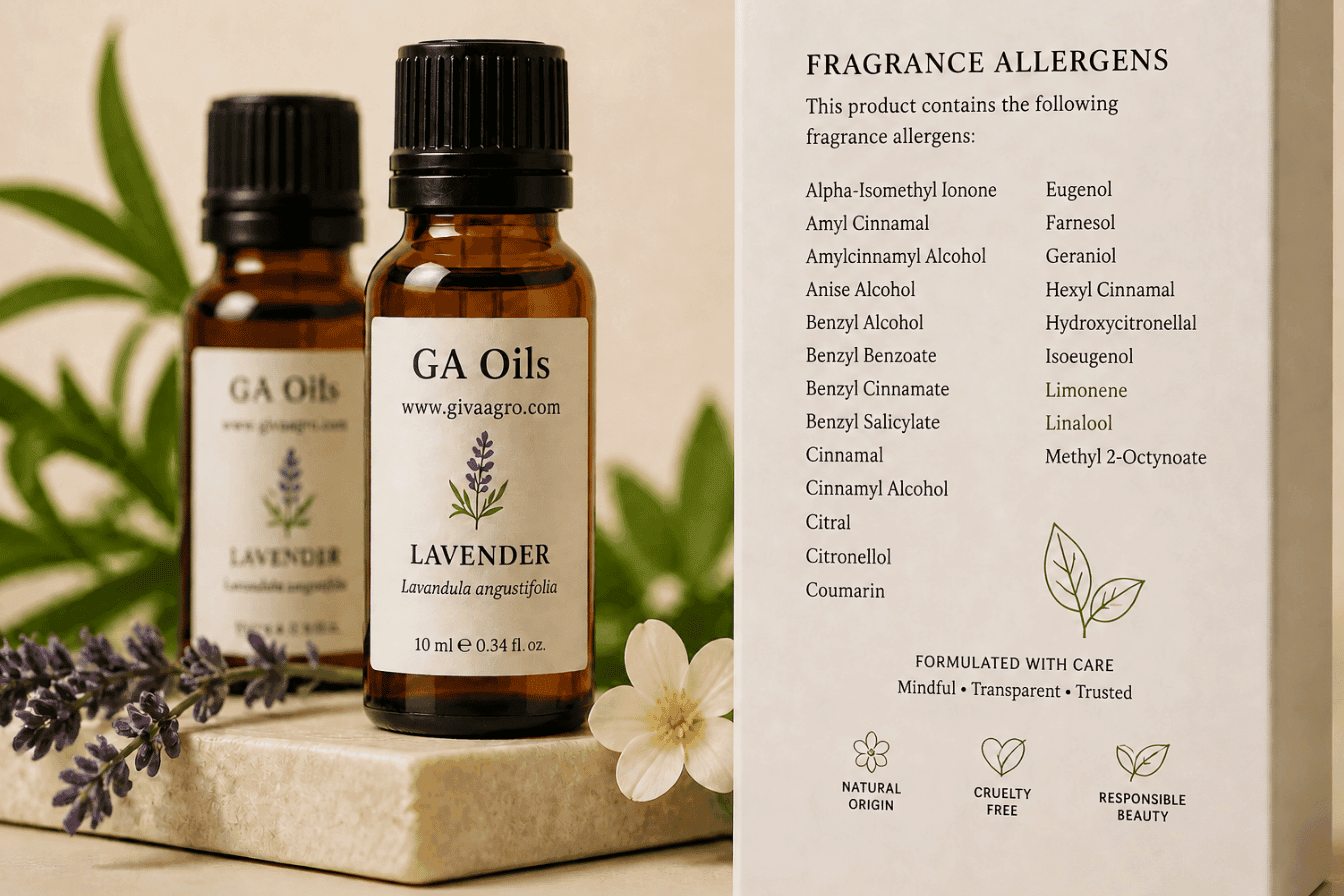
Fragrance allergens above the labelling thresholds must be named in that ingredients list. The list of allergens to declare grew to more than 80 from July 2026, so check every formula containing fragrance or essential oils against our EU fragrance allergen guide. Mandatory text must appear in the language or languages each member state requires.
Checklist: what to get from your manufacturer
Your Responsible Person and safety assessor cannot finish their work without data from the factory. Agree this list with your manufacturer before you approve samples, not after production:
Full quantitative formula, shared with your safety assessor under confidentiality
INCI ingredients list in descending order of concentration
Raw material specifications and Safety Data Sheets for each ingredient
Fragrance documents: an IFRA certificate and an allergen declaration against the current EU list
Stability and packaging compatibility data for the formula in your chosen pack
Microbiological results and, for water-based products, a preservative efficacy (challenge) test
Finished product Certificate of Analysis for each batch (see how to read a COA)
Manufacturing method and GMP statement
Statements on animal testing, nanomaterials and CMR substances
Label dielines for your designer, sized to your pack format
Ask early which of these are included in the price and which, such as challenge or stability tests, are charged separately. They take weeks, and they decide your launch date more than the notification does.
A typical timeline from brief to first EU shipment
Brief and samples. Send a benchmark product, a target price or the claim you want to carry. Samples typically arrive in 7 to 10 working days with a draft INCI list.
Sample approval and documents. The manufacturer releases the formula and data for your safety assessor.
Stability and challenge tests. These usually run for several weeks, so start them as soon as the formula is fixed.
Safety report and label. The assessor completes the CPSR, and your designer finishes the artwork with the final INCI list and allergens.
CPNP notification by your Responsible Person.
Production and shipment. Production typically takes 25 to 35 days ex-works from approval. Custom cartons and labels are usually the critical path.
For how the private label model itself works, see private label vs white label vs OEM.
Common mistakes to avoid
Shipping before the notification is made. The product must be notified before it is placed on the market, and that includes stock listed for sale from an Amazon or other fulfilment warehouse in the EU.
A label that does not match the file. The Responsible Person on the pack must be the one who notified and holds the PIF.
Changing the formula without updating. A new fragrance or preservative means an updated safety report and notification.
Medicinal claims. Words such as "treats eczema" or "cures hair loss" turn a cosmetic into a medicine. Ayurvedic ranges need particular care: claims must meet the EU common criteria for cosmetic claims and be supported by evidence in the PIF.
Forgetting the country of origin. Imported products must state where they were made.
Selling in the UK as well?
Great Britain has its own system. Products sold in England, Scotland and Wales need a UK-based Responsible Person and a notification on the government's Submit Cosmetic Product Notifications (SCPN) service. Northern Ireland follows the EU rules and uses CPNP. The documents behind both are largely the same, so one dossier from your manufacturer can serve both markets.
Frequently asked questions
Does CPNP notification cost anything?
The portal is free. The costs are the safety assessment, any tests and, if you use one, a Responsible Person service.
How long does CPNP notification take?
Entering the notification takes an hour or two, and there is no approval period. The time goes into the safety report and the stability and challenge tests, which together usually take several weeks.
Can my manufacturer in India be the Responsible Person?
No. The Responsible Person must be established in the EU. Your manufacturer supplies the data; you, your importer or a Responsible Person service holds the role.
Do I need a separate notification for each EU country?
No. One notification per product covers the whole EU. A distributor who translates your label to sell in another member state has a short notification duty of its own.
Do I need CPNP if I only sell online from outside the EU?
Yes. Selling to EU consumers online counts as placing the product on the EU market, so you still need an EU Responsible Person and a notification.
What do you supply for EU cosmetic compliance?
For our private label personal care, we supply the INCI list, compositional and safety data for your safety report, input to the Product Information File and a CPNP-ready dossier for your Responsible Person.
Launching a private label cosmetics range for Europe?
We hold more than 450 skincare, haircare, body care, baby, men's grooming, sun care and Ayurvedic formulations. Minimums start at 1,000 units per product, with vegan and cruelty-free options and 21 stock pack formats. Send us a benchmark product or the claim you want to carry, and we will come back with a formulation route, an indicative price and the documents your Responsible Person will need.
Request a quote or samples · Private label cosmetics · Packaging and filling · Download the personal care catalogue (PDF)
Related guides: EU fragrance allergen labelling · Private label vs white label vs OEM · How to read a Certificate of Analysis
Sources: Regulation (EC) No 1223/2009 on cosmetic products · European Commission: Cosmetic Products Notification Portal · GOV.UK: Submit a cosmetic product notification