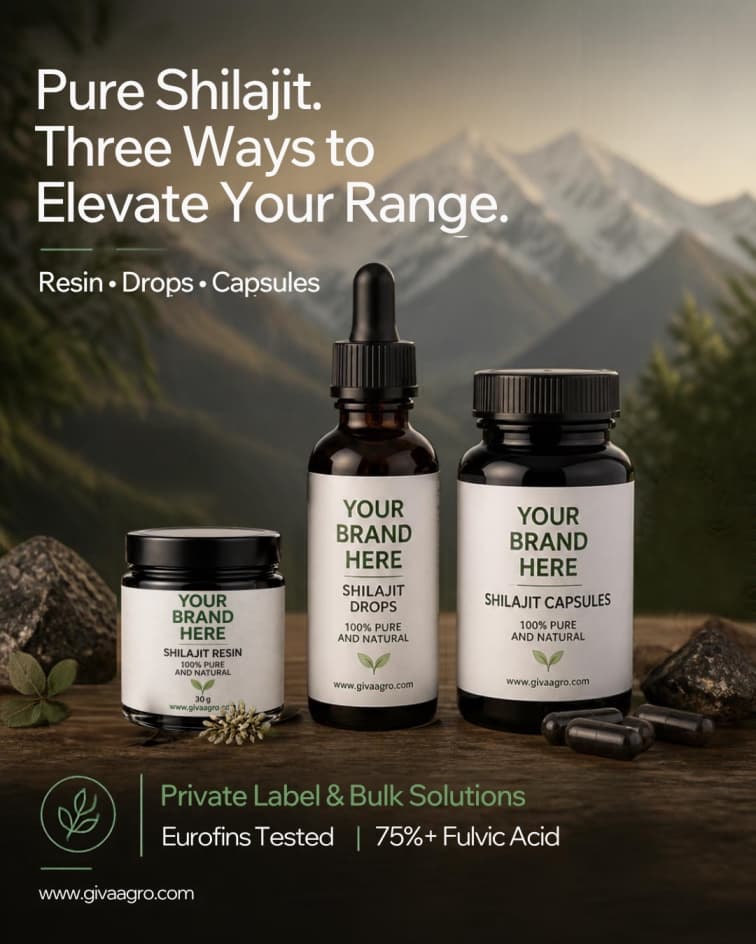
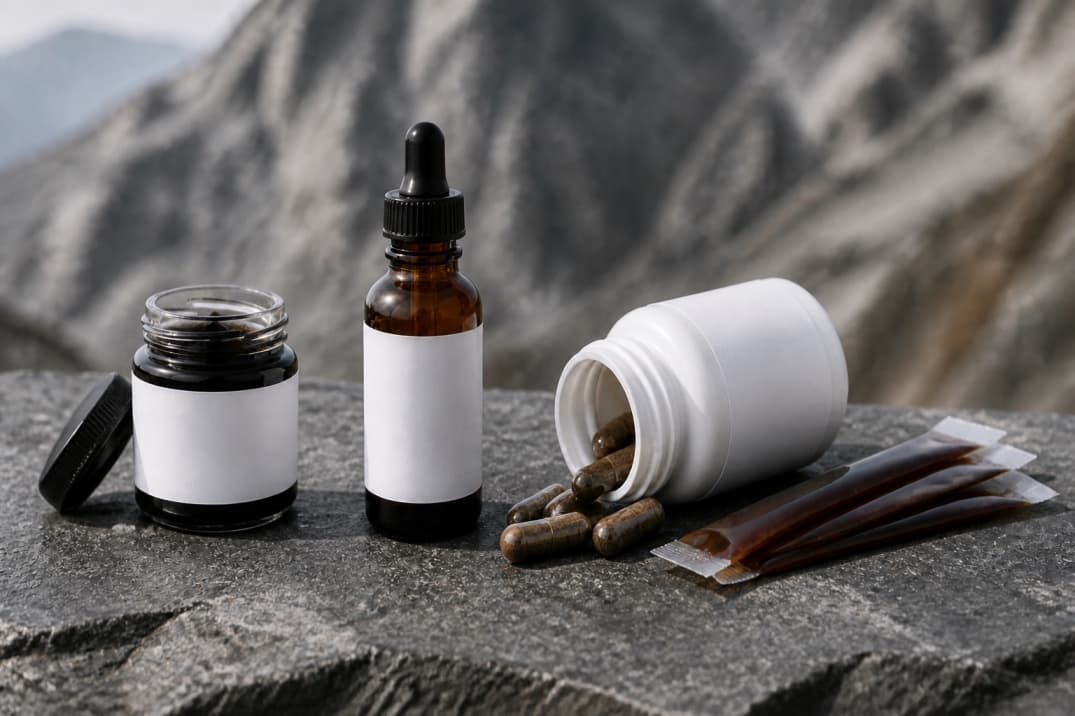
Most Shilajit brands start with resin in a glass jar. It is the format customers recognise, and it looks the most authentic on a shelf. But the format you choose decides much more than the look: how accurately customers dose it, what your packaging costs, which regulatory route applies in your market and how many units you need to order.
This guide compares the four private label and white label Shilajit formats side by side: resin, drops, capsules and honey sticks. Giva Agro is a private labeller and bulk supplier of Himalayan Shilajit, and we make all four from the same purified resin, so the comparison below is about what suits your brand, not what suits our factory.
The short answer
Resin: the premium, authentic choice for direct-to-consumer brands. Highest perceived value, least precise dose.
Drops: convenient and easy to mix into a drink. Needs careful bottling and a clear "shake well" instruction.
Capsules: the most exact dose and the easiest fit for pharmacies, marketplaces and subscription brands.
Honey sticks: single-dose and good for sampling and gifting, but the largest minimum order and the most care with EU rules.
Format 1: Shilajit resin
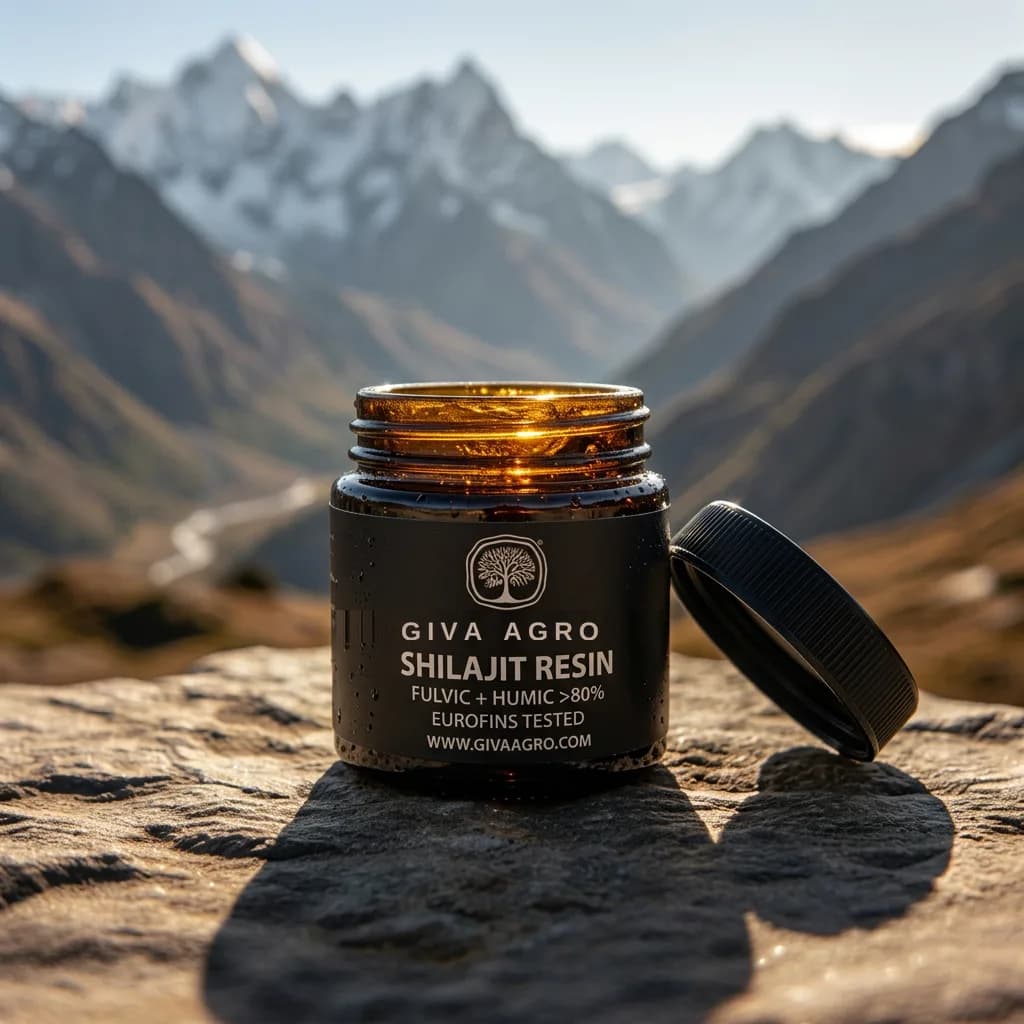
Purified resin, sold in a glass jar with a small dosing spoon. The customer takes a measured portion and dissolves it in warm water or another drink.
Fill sizes: 15 g to 100 g glass jars. Most brands we work with choose 30 g or 50 g.
Dose: measured with a spoon. State the serving in milligrams on the label, not only "a pea-sized portion".
Best for: premium direct-to-consumer brands, gift ranges and customers who want to see the raw material.
Watch out for: texture changes with temperature. Resin firms up in the cold and softens in heat, so plan shipping in summer and tell customers how to store it.
Packaging tip: use glass jars with plastic (HDPE) caps and an inner seal. Resin holds some moisture, which wooden lids absorb once the seal is opened, and metal caps can rust.
Format 2: Shilajit drops (liquid Shilajit)
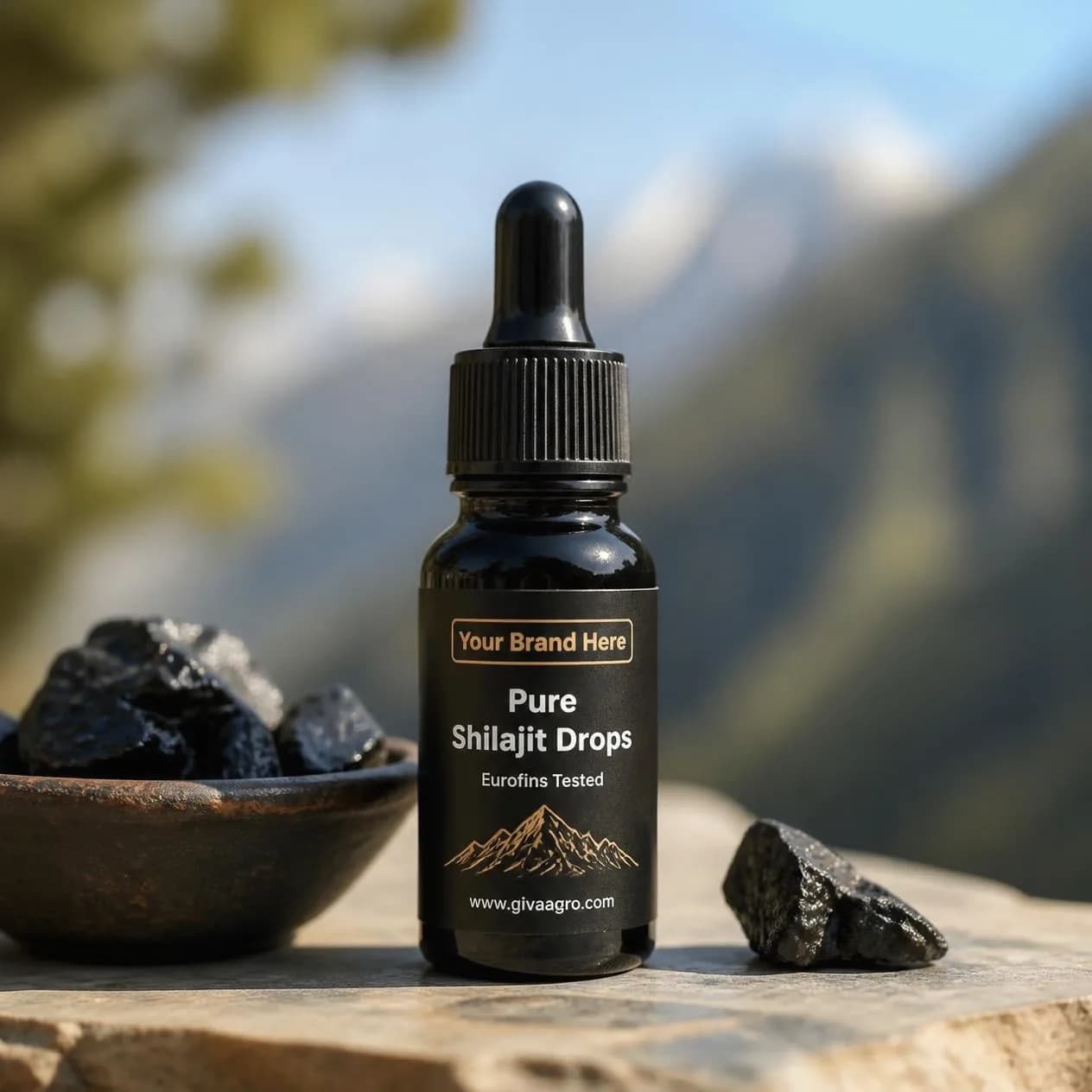
Liquid Shilajit: purified resin dissolved in purified water, with no additives, in a glass dropper bottle.
Fill sizes: 15 ml, 30 ml and 50 ml.
Dose: by millilitre or a set number of drops. Your label should state the Shilajit content per serving.
Best for: brands selling convenience, customers who mix supplements into drinks, and travel-friendly ranges.
Watch out for: with nothing added, the Shilajit naturally settles. The label needs a clear "shake well before use" line, and bottling must be well controlled because a water-based product depends on good microbiological quality.
Packaging tip: amber or black glass, a tamper-evident dropper cap, and protective shipping cartons to prevent leaks.
Format 3: Shilajit capsules
A standardised, spray-dried Shilajit extract powder filled into capsules.
Fill sizes: 500 mg or 800 mg capsules, in packs of 60, 90 or 120.
Dose: exact. Each capsule contains a fixed amount, which makes labelling and dosing instructions simple.
Best for: pharmacies, marketplaces such as Amazon, subscription brands and ranges that sit next to other capsule supplements.
Watch out for: capsules use extract powder rather than raw resin. Ask for the extraction method, the standardisation and every excipient, including the capsule shell. Vegetarian HPMC shells suit most markets.
Packaging tip: HDPE or glass bottles with a desiccant and induction seal, or resealable pouches for refills.
Format 4: Shilajit honey sticks
Single-dose sticks of honey blended with Shilajit.
Fill sizes: 5 g and 10 g sticks, packed in cartons.
Dose: one stick, one serving. Very easy for the customer.
Best for: sampling, gift boxes, gyms and travel retail.
Watch out for: the minimum order is higher, from 5,000 sticks, and the EU status needs care (see below).
How the format changes your regulatory route
European Union. The EU's novel food consultation on mumijo (Shilajit) concluded in 2020 that it is not novel when used as or in food supplements, but it is novel in any other food. In practice, every format you sell in the EU must be presented and labelled as a food supplement, with a recommended daily dose and the standard warnings. This matters most for honey sticks: sold as an everyday honey product, they would fall outside that status.
No health claims are authorised for Shilajit, so keep the label and website free of them.
Fulvic acid is not authorised as an ingredient in its own right. Keep fulvic acid as a specification on the certificate of analysis, not as a claim such as "rich in fulvic acid" on the label.
Our guide to importing Shilajit into the EU covers the documents and labels in detail.
United Kingdom. The UK novel food catalogue lists mumijo (Shilajit) the same way: not novel in food supplements, novel in other foods.
Australia. Most supplements there are regulated as listed medicines, and only ingredients in the TGA's Permissible Ingredients Determination can be used. Several Australian sellers note that Shilajit is not currently a permitted ingredient for listed (AUST L) medicines, so check its status with your sponsor before you plan a range for Australia. Our guide to TGA listing for supplements made in India explains how the system works.
Testing and documents for every format
Whatever the format, the EU sets maximum levels for heavy metals in food supplements: 3.0 mg/kg for lead, 1.0 mg/kg for cadmium in most supplements, and 0.10 mg/kg for mercury. Those limits apply to the product you sell, so ask for results on the finished format, not only on the raw resin.
A certificate of analysis (COA) with every batch, including heavy metals by ICP-MS and microbiology. Our guide on how to read a certificate of analysis explains each line.
The collection region logged against each batch, so you can answer origin questions.
Stability data to support the shelf life on your label.
Third-party reports, such as Eurofins, if your importer or retailer asks for an independent test.
For drops, microbiology matters most. For capsules, ask for the excipient list and the extract specification.
Packaging and branding options
Glass jars from 15 g to 100 g, with branded dosing spoons in a choice of shapes.
Dropper bottles in amber or black glass.
Capsule bottles and refill pouches.
Custom rigid and magnetic gift boxes, tamper-evident seals and serialised batch coding.
Your label and your designer: we send the dielines, and your designer prepares artwork that meets your market's rules.
See the packaging options for jars, closures and boxes.
Minimum orders, lead times and cost
Resin, drops and capsules: private label from 500 units per product.
Honey sticks: from 5,000 sticks.
Bulk: purified resin from 5 kg, in 5 kg and 25 kg food-grade pails, and extract powder in 25 kg drums, for brands that fill and pack themselves. See bulk Himalayan Shilajit.
Samples: 7 to 10 working days.
Production: 25 to 35 days ex-works. Printed cartons and labels are usually the longest step, so approve artwork early.
On cost, capsules give a fixed, predictable cost per serving. Resin usually carries the highest retail price. Drops add the cost of glass droppers, and honey sticks need a larger first run. The right choice depends on your retail price point, not only on unit cost.
Which format should you launch first?
Premium online brand or gift range: start with resin, in 30 g or 50 g jars.
Pharmacy, marketplace or subscription: start with capsules.
Convenience or drinks-focused brand: start with drops.
Sampling, gyms or events: add honey sticks once the core range sells.
A full range: launch resin and capsules together from the same purified batch, so both share one specification and one COA lineage.
Common mistakes
Selling honey sticks in the EU as a food rather than a food supplement.
Putting fulvic acid or health claims on an EU or UK label.
Using wooden lids on resin jars.
Leaving the "shake well" instruction off drops.
Stating the resin dose only as "a pea-sized portion" instead of a weight.
Printing custom boxes before the samples are approved.
Frequently asked questions
What is the minimum order for private label Shilajit?
From 500 units per product for resin, drops and capsules, from 5,000 honey sticks, and from 5 kg for bulk resin.
Can all four formats come from the same batch?
Yes. We make every format from the same purified resin, so a brand can launch a range with one specification and one certificate of analysis behind it.
Can I mention fulvic acid on my EU label?
Keep it on the certificate of analysis as a specification. In the EU, fulvic acid is not authorised as an ingredient in its own right, so avoid claims such as "rich in fulvic acid" and check your label with your compliance adviser.
Can I sell Shilajit honey sticks in the EU?
Only presented as a food supplement, with a daily dose and the required warnings. In other foods, Shilajit is a novel food that needs authorisation.
How long do samples take?
7 to 10 working days, sent with a specification sheet and a batch certificate of analysis.
Related guides
Official sources
Planning a Shilajit range?
Tell us the format, the fill size, your target market and your first-order quantity. You will get a price, a specification and a batch certificate of analysis to check before you commit, and samples in 7 to 10 working days.
See our Shilajit private label range or request a quote and samples.