Shilajit is one of the fastest-growing supplement ingredients in Europe, and one of the most misunderstood. Brand owners ask the same questions before a first order: is it legal, what does the lab report need to show, what can the label say, and which documents will customs and the authorities ask for?
This guide answers those questions for importers and brand owners in the European Union. It is based on the EU rules and on the shipments we prepare for customers in Europe. It is not legal advice: the business that places the product on the EU market, usually you or your importer, remains responsible for compliance.
In short
Legal status: Shilajit (also called mumijo) is not a novel food when sold as or in a food supplement. In other foods it is novel and needs authorisation.
Fulvic acid: isolated fulvic acid is a separate, unauthorised novel ingredient, and "rich in fulvic acid" is not an allowed claim.
Contaminants: food supplements must stay under EU maximum levels for lead, cadmium and mercury, so test every batch.
Labels and claims: the product is labelled as a food supplement in the local language, with no medicinal or unauthorised health claims.
Notification: most Member States require notification of a new food supplement before first sale.
Is Shilajit allowed in the EU?
Yes, as a food supplement. Ingredients that were not eaten to a significant degree in the EU before 15 May 1997 count as novel foods and need EU authorisation before sale. A consultation on mumijo (Shilajit) under the Novel Food Regulation, Regulation (EU) 2015/2283, concluded that it is not novel when used as or in food supplements, because it was sold in supplements before 1997. In any other food it is novel.
Two consequences follow for your range.
Sell it as a food supplement: resin, drops and capsules presented with a recommended daily dose fit the supplement route. A Shilajit snack, drink or confectionery presented as an ordinary food does not.
Sell Shilajit, not fulvic acid: fulvic acid as an isolated ingredient is listed as novel in the EU Novel Food Catalogue and has not been authorised. Shilajit's natural fulvic and humic content is part of its specification, but it should not be marketed as a fulvic acid product.
What about blends?
Every extra ingredient needs its own check. Honey sticks should be presented and dosed as a food supplement, not sold as flavoured honey. Ingredients such as gold or metal bhasmas raise separate questions on novel food status and contaminants, so screen them with your regulatory adviser before launching in the EU.
Contaminant limits and lab testing
Shilajit forms in mineral-rich rock, so heavy metals are the first thing an EU buyer, and an EU inspector, will look at. Regulation (EU) 2023/915 sets these maximum levels for food supplements:
Lead: 3.0 mg/kg
Cadmium: 1.0 mg/kg
Mercury: 0.10 mg/kg
A useful batch Certificate of Analysis (COA) for Shilajit also covers:
Identity and specification: appearance, moisture and the declared fulvic and humic acid content, as quality markers rather than label claims.
Heavy metals: lead, cadmium, mercury and arsenic, with the method and the limit of quantification.
Microbiology: total plate count, yeasts and moulds, E. coli and Salmonella.
Extra panels on request: polycyclic aromatic hydrocarbons (PAHs) and pesticides, which some buyers and retailers ask for.
For a first order, many importers ask for an independent test at an ISO/IEC 17025 accredited laboratory on the same batch that will be shipped. A simple protocol works well: one homogenised batch, jars or samples drawn at random, testing before release, and confirmation that the shipped goods come from the tested batch. Our guide How to read a Certificate of Analysis explains what to check on the report.
Labelling a Shilajit food supplement
The general food labelling rules in Regulation (EU) No 1169/2011 apply, together with the specific rules for food supplements in Directive 2002/46/EC. The label must be in a language consumers in each country understand, usually the national language. It needs:
The name "food supplement": the legal name of the product category.
Characterising substance: the name of the substance that characterises the product, here Shilajit, and its amount per daily portion.
Recommended daily portion: with a warning not to exceed it.
Mandatory statements: that food supplements should not replace a varied diet, and that the product should be kept out of reach of young children.
Standard food information: net quantity, best-before date, batch code, storage conditions and the name and address of the EU business responsible.
What you can and cannot claim
The EU allows only authorised nutrition and health claims, under Regulation (EC) No 1924/2006. There is no authorised health claim for Shilajit.
Avoid: any claim to prevent, treat or cure a disease, and health claims about energy, testosterone, immunity or performance linked to Shilajit.
Avoid: "rich in fulvic acid" or "source of fulvic acid", which are not permitted nutrition claims.
Possible: factual product descriptions such as origin, form and purification method, and authorised claims for other ingredients that meet the conditions of use, such as a vitamin added at a qualifying level.
The same rules cover your website, marketplace listings and social media posts, not just the pack.
Notification before first sale
Most EU Member States require a food supplement to be notified to the national authority before or when it is first placed on the market, usually by sending a copy of the label. Examples include the BVL in Germany, the TeleIcare portal in France, the Ministry of Health in Italy, the Chief Sanitary Inspectorate (GIS) in Poland and the Ministry of Agriculture in the Czech Republic. Our EU food supplement import checklist covers notification country by country.
Documents for customs and your importer
Commercial invoice and packing list: with the batch numbers and an agreed tariff (HS) code. Agree the code with your customs broker before the first shipment.
Certificate of Origin: issued through the Indian export authorities.
Batch COA: plus the independent laboratory report where agreed.
Product specification: composition, purification method, shelf life and storage conditions.
Manufacturer's licences and certificates: such as the FSSAI licence, GMP and HACCP certificates, and a Certificate of Free Sale.
Some countries inspect imported food before customs release. Poland's sanitary inspection, for example, may hold a consignment until it has reviewed the documents or tested a sample, so build that time into your first delivery date.
Your first order, step by step
Confirm the route: food supplement, with the forms and ingredients you plan to sell.
Approve samples and the specification: including the contaminant limits from Regulation (EU) 2023/915.
Prepare the label: mandatory particulars in the local language and no unauthorised claims.
Notify the product: in each Member State where you will sell it.
Test the production batch: with the manufacturer's COA and, for a first order, an independent report.
Ship with complete documents: and allow time for any import inspection.
Five mistakes that delay a Shilajit launch
Marketing fulvic acid instead of Shilajit: it turns a permitted supplement ingredient into an unauthorised novel one in the customer's eyes and the inspector's.
Copying claims from US or Indian websites: energy, testosterone and "detox" claims are not allowed on EU labels or adverts.
Accepting a COA without heavy metal limits: results are only useful against the EU maximum levels.
Selling Shilajit as an ordinary food: outside the supplement route it is a novel food.
Leaving notification until after launch: in most countries it must be done before or on first sale.
Frequently asked questions
Is Shilajit legal in Germany, France and Poland?
Yes, as a food supplement, subject to the national notification and labelling rules. In other foods it would need novel food authorisation.
Can I write the fulvic acid percentage on the label?
The fulvic and humic content belongs in the specification and on the COA. Do not present it as a nutrition or health claim, such as "rich in fulvic acid".
Do Shilajit drops and capsules count as food supplements?
Yes, when they are presented with a recommended daily dose and labelled as food supplements. Check any added ingredient separately.
Which lab tests should I ask for?
Heavy metals (lead, cadmium, mercury and arsenic), microbiology, and the identity and specification tests, with PAHs and pesticides if your customers or retailers ask for them.
Who notifies the product?
The business placing it on the market in each country, usually you or your importer. The manufacturer supplies the label data and supporting documents.
Planning a Shilajit range for Europe?
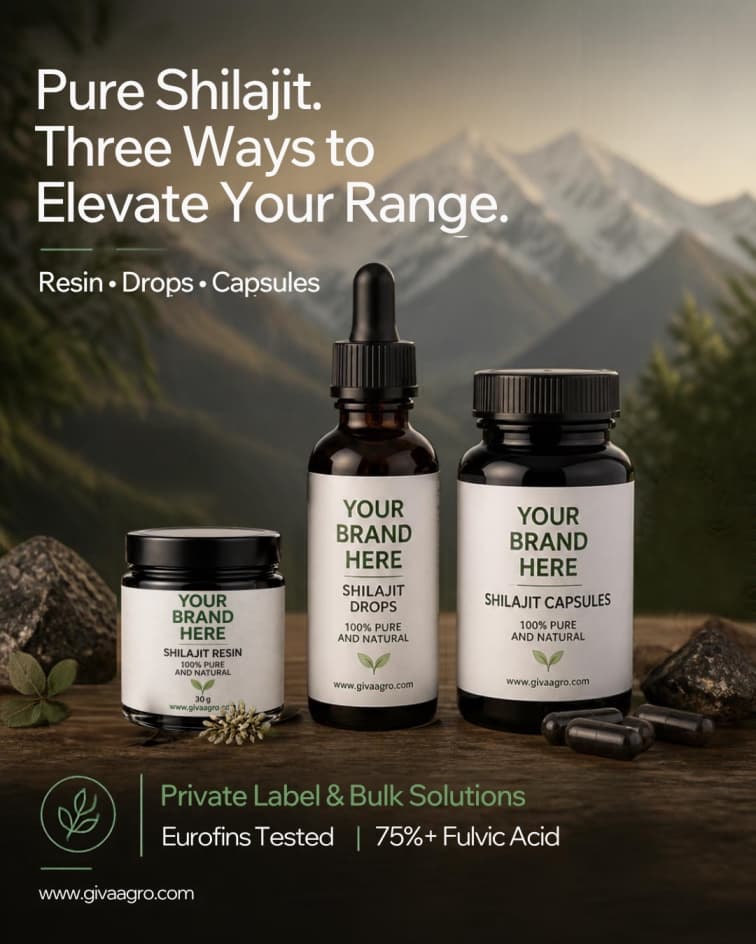
We supply Himalayan Shilajit as resin, drops, capsules and blends, in bulk or under your label, with a COA for every batch and independent testing on request. Tell us your market, format and volume, and we will send a specification, samples and indicative pricing.
Request samples or a quote · Shilajit private label · Himalayan Shilajit range
Related guides: Importing dietary supplements into the EU · How to read a Certificate of Analysis · Private label nutraceutical manufacturing
Sources: European Commission, consultation on the novel food status of mumijo · EU Novel Food Status Catalogue · Regulation (EU) 2023/915 on contaminants · Directive 2002/46/EC on food supplements · Regulation (EC) No 1924/2006 on claims